
The water damage restoration process is not improvised — it is a defined, science-based sequence that the best restoration companies follow on every job. Understanding it helps you know what to expect, what good work looks like, and how to tell a professional from an opportunist. At Flood Doctor, every project across Northern Virginia, DC, and Maryland follows the IICRC S500 standard — the gold standard of the industry — from the first emergency call to final reconstruction. Have an active loss? Call (877) 497-0007 and we will walk you through it.
Whether your water damage came from a burst pipe, a failed appliance, a storm, or a flood, the underlying restoration process is remarkably consistent. What changes is the scope and the category of water. Below is exactly how we restore a water-damaged property, step by step, and why each phase matters.
Step 1: Emergency Contact & Rapid Response
The clock starts the moment you call. We answer 24/7 and dispatch IICRC-certified crews that arrive within 60 minutes. Speed is everything: within 24 to 48 hours, mold can colonize and clean water degrades to contaminated water. Our emergency services are built around this first critical hour.
Step 2: Inspection & Damage Assessment
Before any equipment goes down, we determine the true scope. Using thermal imaging cameras and calibrated moisture meters, we map the full extent of the intrusion — including hidden moisture behind walls and under floors — and identify the category of water (clean, gray, or black). This assessment defines the entire restoration plan and establishes the documentation that supports your claim.
Step 3: Water Extraction
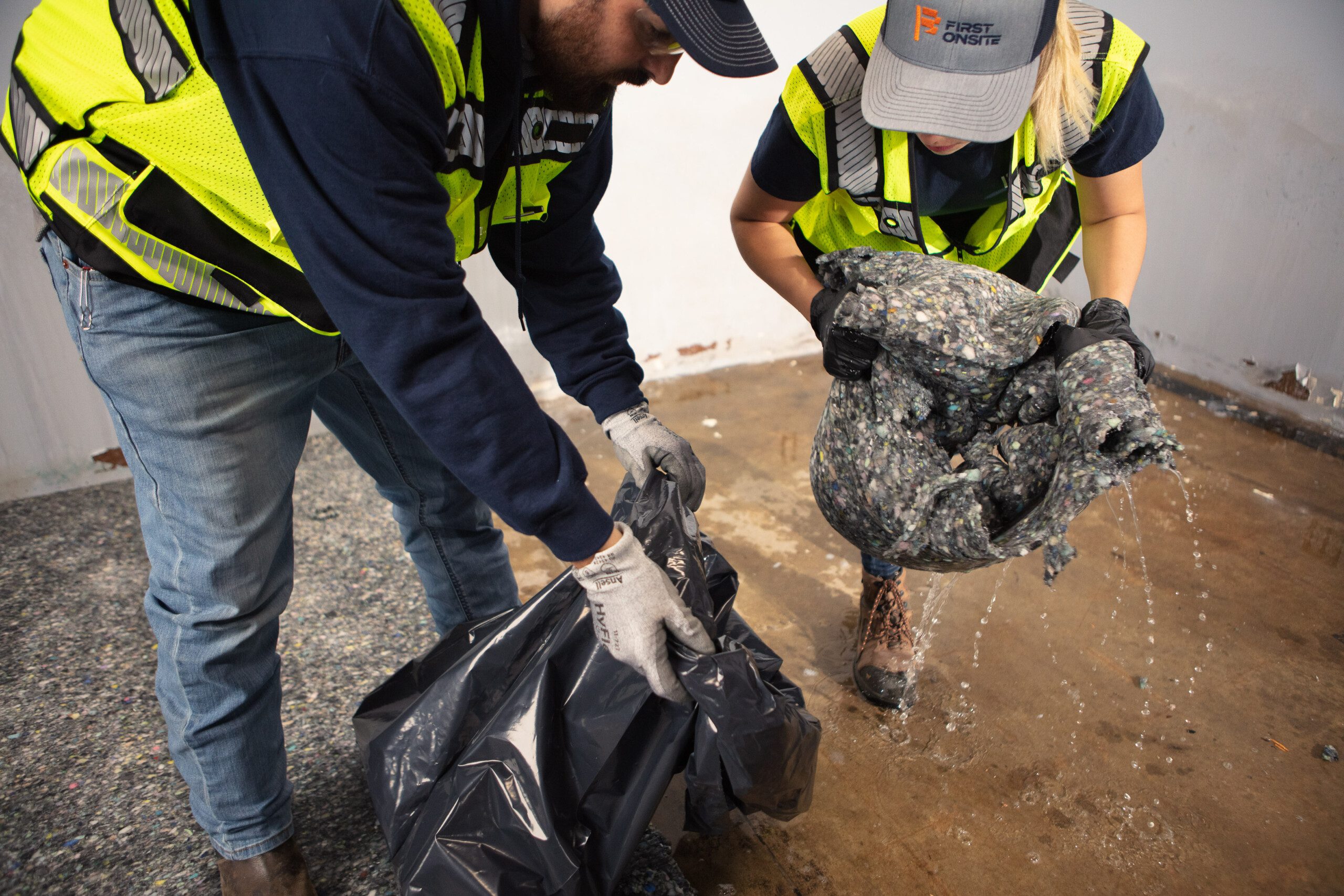
Truck-mounted and portable extractors remove standing water as fast as possible — thousands of gallons per hour. The more water removed mechanically, the less the structure must release through slower evaporation, which shortens the entire timeline. Learn more about water extraction.
Step 4: Drying & Dehumidification
This is the heart of the process. We deploy commercial LGR dehumidifiers and high-velocity air movers, engineered with psychrometric calculations for your specific space and materials. We monitor moisture daily and adjust equipment until the structure reaches dry standard — typically 3 to 5 days for residential losses. This is where corners are most often cut, and where mold problems are born. See our structural drying service for the science.
Step 5: Cleaning & Sanitizing
We clean and sanitize all affected surfaces and contents, applying EPA-registered antimicrobials to prevent mold and bacterial growth. For contaminated water events, this phase escalates to full decontamination. Salvageable belongings are cleaned and, when needed, restored off-site.
Step 6: Restoration & Reconstruction
The final phase returns your property to pre-loss condition — from minor drywall and paint to full reconstruction of flooring, cabinetry, and structural elements. Because we handle repair and reconstruction in-house, the transition from drying to rebuild is seamless, with one project manager throughout.
The Three Categories of Water
The restoration process adapts to the category of water involved, as defined by IICRC standards:
- Category 1 (clean water) — from supply lines. Lowest risk, but degrades within hours if left standing.
- Category 2 (gray water) — from appliance overflows and sump failures. Requires antimicrobial treatment.
- Category 3 (black water) — from sewage and flooding. Hazardous; requires full PPE, material removal, and clearance testing.
How We Know When Restoration Is Complete
We do not guess. We establish a dry standard by measuring moisture in unaffected areas of the same materials, and drying is complete only when affected areas match it. Every reading is documented, creating an objective record that proves the structure is dry — for both you and your insurer. This data-driven approach prevents under-drying (which leaves moisture for mold) and over-drying (which wastes money).
Insurance Built Into the Process
Documentation is not an afterthought in our process — it runs through every phase. From the first photos and moisture readings to the final reconstruction estimate in Xactimate, we build the evidence carriers need to approve your claim. With 8,000+ claims processed at a 98% approval rate, we file and bill your carrier directly. Start at our claims page or read about insurance claim help.
Why Northern Virginia Trusts Flood Doctor
We are a licensed Virginia Class A contractor (DPOR #2705155505), licensed in Washington, DC and Maryland, with IICRC-certified technicians who follow the S500 process on every job. We serve homeowners and businesses throughout the region, including Fairfax, Arlington, McLean, and Ashburn. A defined process, executed by certified people, with documented results — that is what restoration done right looks like.
Start the Process Now
If you have water damage, the process starts with one call. Reach Flood Doctor at (877) 497-0007, or request service online. We are based at 8466D Tyco Rd, Vienna, VA 22182, and serve Northern Virginia, DC, and Maryland 24/7.