Commercial dehumidification services remove the moisture that ordinary fans and HVAC systems leave behind — the trapped humidity that fuels mold, corrosion, warping, and persistent musty odors. Whether you are drying out a water-damaged warehouse, controlling humidity in a data center or archive, or completing a large-loss restoration, Flood Doctor deploys industrial LGR and desiccant dehumidifiers with the engineering to back them up. Serving Northern Virginia, DC, and Maryland 24/7, our IICRC-certified team sizes, places, and monitors the right system for your space. Call (877) 497-0007.
Humidity is invisible, but its damage is not. In Northern Virginia’s humid climate, excess moisture in a commercial building quietly degrades inventory, corrodes equipment, delaminates flooring, and creates the conditions for mold to spread through walls and HVAC systems. Effective dehumidification is not about running bigger fans — it is about pulling water vapor out of the air faster than it accumulates, and verifying the result with data.
LGR vs. Desiccant: The Right Tool for the Job
The two dominant technologies in commercial dehumidification work differently, and choosing correctly is half the battle:
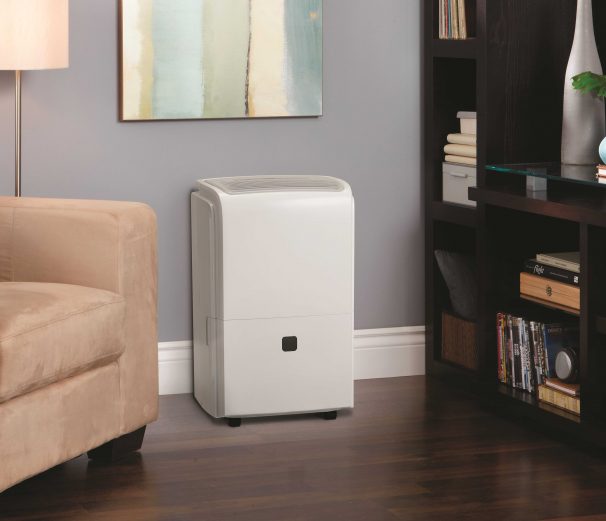
- LGR (low grain refrigerant) dehumidifiers — highly efficient in warm, moderately humid conditions. Each unit can extract well over 17 gallons of water per day. Ideal for typical water-loss drying.
- Desiccant dehumidifiers — use moisture-absorbing media to drive humidity far lower than refrigerant units can, and they keep working in cold conditions. Essential for drying dense materials like concrete, for low-temperature environments, and for moisture-sensitive applications.
We frequently combine both, plus high-velocity air movers, to engineer the optimal drying environment for your specific structure and contents.
When Commercial Dehumidification Is Critical
- Large-loss water damage — warehouses, offices, hospitality, healthcare, and multifamily properties.
- Concrete and slab drying — where deep, dense moisture must be driven out before new flooring goes down.
- Moisture-sensitive environments — data centers, archives, museums, manufacturing, and storage facilities.
- Ongoing humidity control — basements, crawl spaces, and below-grade areas prone to chronic dampness.
- Post-flood and post-fire drying — as part of complete structural restoration.
Our Dehumidification Process
1. Psychrometric Assessment
We measure temperature, relative humidity, dew point, and grain depression to understand the moisture load and calculate the exact dehumidification capacity your space requires.
2. System Design & Sizing
Undersized equipment never finishes the job; oversized equipment wastes money. We size the system to the load and the materials, selecting LGR, desiccant, or a hybrid approach.
3. Strategic Deployment
Dehumidifiers and air movers are placed to maximize evaporation and capture — engineered placement, not guesswork — and integrated with our structural drying systems.
4. Daily Monitoring & Documentation
We track humidity and material moisture daily, adjusting equipment as conditions change, and document every reading. For complex projects, our thermal imaging and moisture mapping confirm hidden areas are drying.
Why Dehumidification Prevents Mold and Protects Assets
Mold requires moisture; corrosion requires moisture; wood rot requires moisture. By driving relative humidity down to safe levels and holding it there, commercial dehumidification removes the one ingredient every form of moisture damage depends on. For businesses, that means protected inventory, equipment, and structures — and continuity of operations. When mold has already taken hold, our mold remediation teams handle containment and removal.
Minimizing Business Disruption
We understand downtime costs money. Our crews work around your operations where possible, deploy quiet and energy-efficient equipment, and document run times for your insurance claim. The goal is to get your facility dry and back to full operation as fast as the science allows. With 8,000+ claims processed at a 98% approval rate, we bill your carrier directly — start at our claims page.
Why Northern Virginia Businesses Trust Flood Doctor
We are a licensed Virginia Class A contractor (DPOR #2705155505), licensed in Washington, DC and Maryland, with IICRC-certified technicians and a 500+ unit equipment fleet sized for jobs of any scale. We serve commercial and residential clients throughout the region, including Fairfax, Arlington, McLean, and Ashburn, and we handle large-loss commercial drying that smaller firms cannot.
Get Commercial Dehumidification Now
Excess humidity damages assets every hour it persists. Call Flood Doctor at (877) 497-0007 for commercial dehumidification services, or request service online. We are based at 8466D Tyco Rd, Vienna, VA 22182, and serve Northern Virginia, DC, and Maryland 24/7.